


National Geographic 1991 November
Publisher: National Geographic
Format: Paperback
ISBN: none
National Geographic, November 1991: the issue that looks you straight in the eye and says, “Yes, you can absolutely cross a raging river on a woven wheel of sticks. No, you personally should not attempt it. Please sit down and turn the page.”
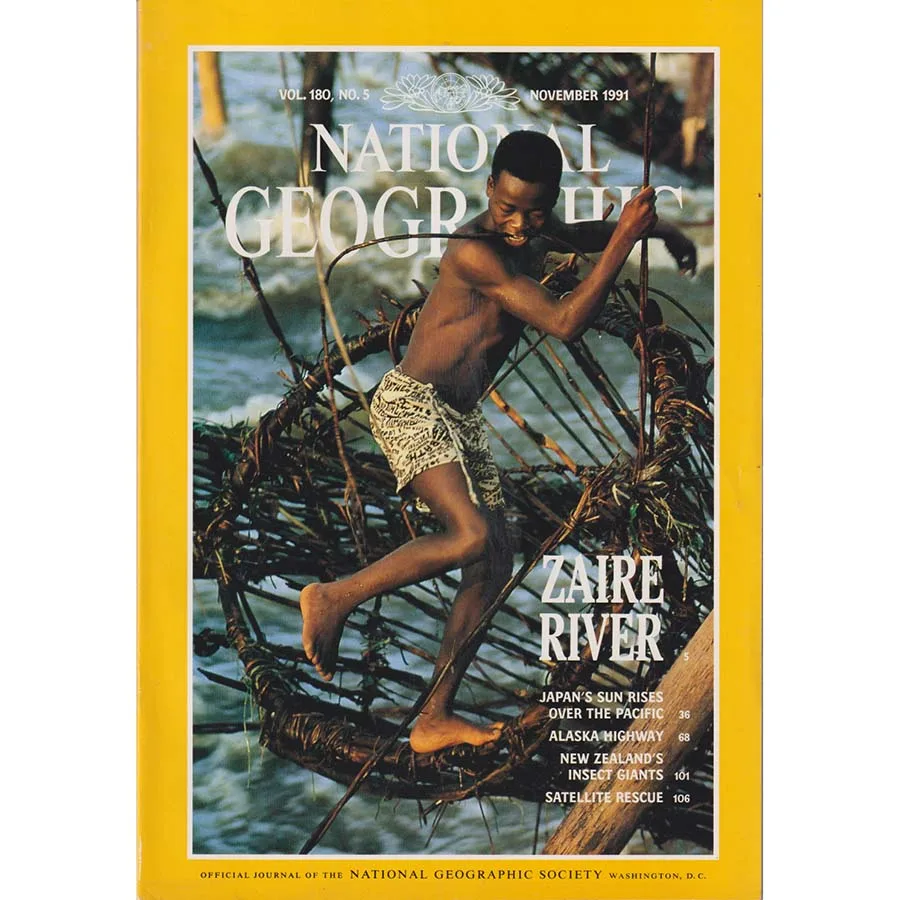
The cover feature is Zaire River, and the photograph is gloriously, quietly bonkers: a boy balanced on what appears to be a hand-made floating contraption that’s half basket, half merry-go-round, half “how is this not a museum piece?” It’s the sort of image that makes modern life feel embarrassingly over-engineered. You’ve got apps to track your steps; he’s got a river, a current, and a circular raft built from local materials and sheer nerve. The irony lands instantly: National Geographic is selling you exploration, and the most adventurous thing on the cover is a reminder that people have been innovating in practical, elegant ways long before anyone coined the phrase “disruptive technology.”
Inside, you’re in classic Nat Geo territory: a big river as a living system—transport, food, danger, economy, culture, and an entire worldview flowing from source to sea. Rivers don’t just run; they organise human lives. This is the kind of feature that makes you look at your local canal or muddy stream with a new respect, then immediately remember you don’t have to navigate it on a woven float while carrying your daily errands.
And then—because National Geographic refuses to keep a single focus for more than twelve seconds—you get a supporting menu that reads like someone spun a globe, threw a dart, and then did it three more times for good measure:
-
Japan’s Sun Rises Over the Pacific – poetic title, serene vibes, the sort of piece that makes you want to drink tea slowly and consider your relationship with mornings. Also, in 1991, “Pacific” still feels like a promise rather than a spreadsheet.
-
Alaska Highway – the antidote to serenity: long distances, weather, grit, big landscapes, and the subtle thrill of a road that feels like a dare someone accepted decades ago.
-
New Zealand’s Insect Giants – because the only thing better than adorable wildlife is wildlife that makes you say “why is it that large?” Expect wonder, mild alarm, and the kind of close-up photography that turns a bug into a mythological beast.
-
Satellite Rescue – the early-90s flavour of high-tech heroics. A reminder that exploration isn’t just boots and boats; sometimes it’s maths, machinery, and humans trying to recover something expensive from a place it absolutely shouldn’t be.
It’s a wonderful, slightly chaotic issue: one minute you’re watching a river carry whole communities; the next you’re in Japan with the dawn; then you’re on a road through Alaska; then you’re making uneasy peace with the idea of very large insects; then you’re in orbit, politely panicking.
Condition: Good, which is exactly what you want for a 1991 National Geographic: sturdy, readable, and rich with that old-school magazine confidence—long features, serious photography, and a vibe that assumes you’ll happily spend your evening time-travelling the planet without once checking your phone. Sold by Crappy Old Books, naturally, because the best way to acquire a woven river-wheel adventure, Pacific sunrises, an Alaskan road trip, giant insects, and a dash of satellite drama is from a seller whose name suggests bargain shelves, treasure hunts, and the occasional astonishing find.
If you like your geography with a side of “how did humans even think of that?”—November 1991 is a cracking ride. Just… please don’t build the raft.
Keep browsing: See more National Geographic books Other books by National Geographic
